Executing Strategy Consistently - Using Flight Levels® and OKRs
Authors: @Bert Klingsporn, @Daniel Funk
Sound familiar? Your company has a clear strategy, but implementation is faltering. Your teams are constantly working at full capacity, constantly reprioritizing – and yet the really important goals are not being achieved.
In many cases, the cause is that the corporate strategy is not consistently linked to the implementing organization. Top managers often assume that their company is strategically aligned. However, our experience shows that strategic alignment can decrease as early as the next management level and continue to decrease all the way down to the implementation teams. This relationship is also referred to as the strategy gap. Improved top-down communication alone is not enough to close this gap – in our view, strategy execution is an ongoing process. To address this, we have developed an improvement approach that uses Flight Levels® and OKRs. Our approach takes into account the individual situation and specific context of a company or organization and is based on five success factors: focusing, outcome orientation, linking value creation, shared clarity and adaptability.
Focusing
The strategic situation is visualized on a Flight Level 3 Board at the beginning. This makes it visible to everyone. This visualization can be done at the company level, at the level of individual organizational areas, or at the level of particularly important topics such as digitization, innovation, or internationalization. The underlying facts or hypotheses should also be communicated. Dr. Klaus Leopold, the creator of Flight Levels®, aptly describes this as “freeing strategies from the slides”. It should be noted that this can be a challenging process. In practice, we often see a large number of extensive strategy papers in companies and organizations. In our view, a clear reduction, targeted selection and concentration on the most important goals for the implementation period, for example one year, is expedient. The feedback from the implementing organization should be taken into account. This reduces the need for interpretation and ensures a reality check. It is also important to know which topics are independent of the strategy, for example due to legal requirements.
Reflection questions for you:
Which strategic goals are really crucial for your company in the next 12 months?
How well do your teams know the strategic goals and can therefore focus more clearly?
Outcome orientation and linking value creation
The next step is to define the top-level OKRs for the implementation period. They should be prioritized to make it clear what has the highest priority in the period under consideration. Without clear prioritization, there is a risk of local optimizations during implementation that may not be in the interest of the company as a whole.The top-level OKRs are linked to existing and new strategic implementation initiatives. In practice, it has proven beneficial to further intensify the exchange with those responsible for implementation at this point. This helps to improve the key results and better assess how many OKRs and initiatives can be achieved with the given budget or capacity constraints. Here, a further prioritization step is often necessary, this time for the initiatives.
Reflection questions for you:
How do you and your company ensure that teams only work on the most important initiatives?
How well can your company measure the value contribution of strategic initiatives?
Shared clarity and adaptability
The result is a strategic portfolio that focuses on overarching initiatives and outcomes:
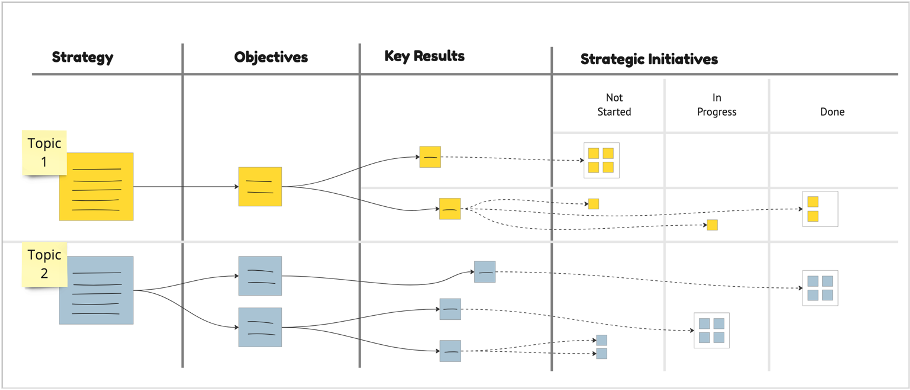
This portfolio is not a static object, but requires continuous and active participation of those responsible for strategy and implementation - integrated into regular management and reporting processes. Is the portfolio developing in line with the agreed objectives? Which initiatives should be newly introduced, adapted or discontinued? Are there any repercussions of implementation on strategic direction? This kind of clarity fosters a culture of trust in which consistent solutions for adjustments and optimizations can be developed in both directions.
Reflection questions for you:
How regularly do you and your company review the effectiveness of strategic initiatives?
How good is the flow of information between the strategy and implementation levels – in both directions?
In summary: a lot of potential to be tapped
Understanding strategy implementation as a continuous process with Flight Levels® and OKRs provides greater visibility into the relationship between priorities, activities and results. This fosters consistent strategy execution and holds significant potential: greater efficiency, better results, more innovation, faster response to market changes and greater satisfaction of all parties involved.
About the authors
Bert Klingsporn is a management consultant for strategy & transformation with over 25 years of experience and a deep understanding of how business models, strategies, processes and ways of working can be constructively challenged, purposefully transformed and effectively anchored.
Daniel Funk is an enabler who inspires and empowers companies to drive change in a clear and effective way.
Would you like to learn more about how we approach your challenge? Please feel free to contact us:
FAQ
What are Flight Levels®?
Flight Levels® is a model for effectively organizing collaboration across different levels of an organization. It distinguishes three levels: Flight Level 1 for operational teams, Flight Level 2 for coordination between teams, and Flight Level 3 for strategic portfolio management. The model helps companies to make work transparent across all levels and to optimize the value flow.
What are OKRs (Objectives and Key Results)?
OKR is a method for setting and tracking objectives. Objectives (O) are ambitious, qualitative goals that describe WHAT is to be achieved. Key Results (KR) are measurable results that show HOW well the objective has been achieved. OKRs create a clear framework for focused work through their transparency and regular review.